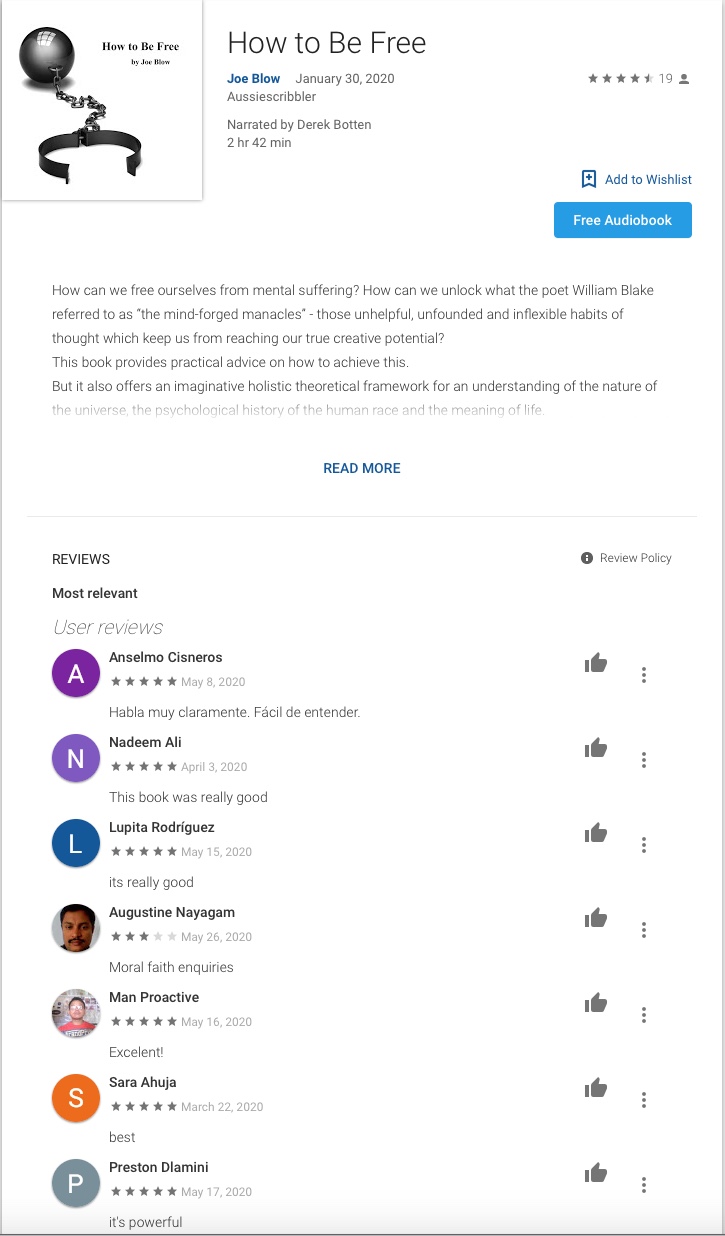
This book is a Get Out of Jail Free card and a passport back into the playground.

The aim of this book is to set you free. But free from what? Free from neurosis. Free from the feeling that you have to obey authority. Free from emotional intimidation. Free from addiction. Free from inhibition.

The key to happiness, mental health and being the most that we can be is absolute and unconditional self-acceptance. The paradox is that many of our problems are caused by trying to improve ourselves, censor our thinking, make up for past misdeeds and struggling with our negative feelings whether of depression or aggression.

But if we consider ourselves in our entirety in this very moment, we know these things :

1. Anything we have done is in the past and cannot be changed, thus it is pointless to do anything else but accept it. No regrets or guilt.

2. While our actions can harm others, our thoughts and emotions, in and of themselves, never can. So we should accept them and allow them to be and go where they will. While emotions sometimes drive actions, those who completely accept their emotions and allow themselves to feel them fully, have more choice over how they act in the light of them.

Self-criticism never made anyone a better person. Anyone who does a “good deed” under pressure from their conscience or to gain the approval of others takes out the frustration involved in some other way. The basis for loving behaviour towards others is the ability to love ourselves. And loving ourselves unconditionally, means loving ourselves exactly as we are at this moment.

This might seem to be complacency, but in fact the natural activity of the individual is healthy growth, and what holds us back from it is fighting with those things we can’t change and the free thought and emotional experience which is the very substance of that growth.


How to Be Free is available as a free ebook from Smashwords, iBooks in some countries, Kobo and Barnes & Noble

The audiobook is available for free from iTunes and Google Play.

It is also available in paperback from Lulu or Amazon for $10 US, plus postage.

The ebook version currently has received 1,163 ***** out of ***** ratings on U.S. iBooks.

The audiobook version currently has received 128 ***** out of ***** ratings on U.S. iBooks and a 4.5 out of 5 average from 103 ratings on GooglePlay.

Friday, 17 July 2020

The Empire of the Most Easily Triggered

Photo by ruslanshug

In How to Be Free I argue that neurosis is the norm for humans. By this I mean that we have an insecurity about our own worth which makes us especially prone to negative emotions. As a result our ego - our conscious thinking self - is preoccupied with self-defence - we are ego-embattled. Our rigidly defensive personality can be conceived of as our character armour (to take a concept from the psychiatrist Wilhelm Reich). It is a protection against threats from without - the criticism of others - and within - any potentially disorienting emotion, such as fear, anger or grief, or impulse, such as sexual lust, which we keep repressed.

The more embattled the individual, the more important it is to maintain strict control over their own psychology, and this may be paralleled with an impulse to control the social world around them. So I expressed the view in my book that this need might explain oppressive rule, with those who are most insecure about their own worth feeling the need to rise to the top of the hierarchy and impose discipline on the masses. That may be a bit over-simplistic, as competent leadership can also bring people to the top of a hierarchy. Not all leaders are tyrants. It may, however, go some way to explaining the motivation behind tyranny. After all, the life of a tyrant can be a harsh and unpleasant one, and so a fear-based need may explain the surrendering of opportunities for care-free enjoyment.

At the moment we are faced with a different kind of authoritarianism - the decentralised authoritarianism which arises from Critical Social Justice Theory and its mob-enforced political correctness. It is no coincidence that the tertiary institutions where this new dogma was born also popularised the “safe space” and the “trigger warning”. Insecurity is the driving force behind this form of authoritarianism as well.

In some ways this could be seen as a reverse of the phenomena which Critical Social Justice Theory is ostensibly aimed at addressing.

While racism may have originated in tribal conflicts and sexism in friction resulting from the division of labour between nurturers and group protectors, it becomes ever more severe through a process of negative feedback as individuals become more and more insecure. These responses rigidified into armouring. The insecure individual dehumanises, silences and attacks those he has already exploited or mistreated in some way, because they are to him the outer mirror of that quiet voice inside which tells him he is doing wrong. Of course there can be other aspects of the phenomena arising from something like repressed sexuality which causes him to see members of another race as sexually dangerous or to see women’s sexuality as a threat.

The insecurity which arises from Critical Social Justice Theory is different, but it can lead to a similar kind of fear-based oppression.

What we need to be aware of is the inability to tolerate difference, in this case difference of opinion. The secure individual may view another individual’s difference of opinion on some key question as a challenge, but they will not interpret it as a personal attack.

I think what has happened with Critical Social Justice Theory is that it provides a false explanatory structure for the world. A sound explanatory structure will have a healing effect on the traumatic wounds an individual may be carrying. It will make the individual more courageous and less resentful. It will give them a way of understanding any bad treatment they have experience in life as something which doesn’t reflect badly on them as an individual and direct them toward a positive strategy to addressing the injustices they find in the world around them now. It will make them more tolerant of differing opinions and better able to engage in productive discourse with those who hold them.

But Critical Social Justice Theory is a poor explanatory structure which feeds on the wounds of the traumatised individual, encouraging feelings of resentment and directing them against anything, such as reason and evidence, which might undermine that explanatory structure. It encourages confirmation bias.

Just as racists and sexists are easily triggered, and thus have tried to maintain control over society in order to keep their fears or guilts at bay, so those who have a very poor explanatory structure as their only strategy to live with whatever wounds they are carrying - and the anxiety which arises from them - will end up trying to exercise control over any social manifestation of the realities this explanatory structure is in denial of.

I keep coming back to Biblical concepts, even though I’m not a believer in the supernatural.

To me the Kingdom of Heaven is the society which would arise if our insecurity about our own worth were healed. It is the absence of the control impulse. Love is open, honest, spontaneous and generous communication. It is a process which brings us together naturally when we give up trying to control each other. Reason and evidence provide the grounding for this as they are the way in which we discover our collective reality.

Critical Social Justice Theory is an attack on love and reason. Thus I identify it with the Anti-Christ, that which falsely claims to be solving the world’s problems but actually is anti-The Kingdom of God.

We are told, in the Bible, that there will be a final conflict before the arrival of the Kingdom of God, that there will be a Judgement Day and many will be thrown into The Lake of Fire.

If you are caught up in a false explanatory structure which is your strategy for holding all your psychological pain at bay and you are telling yourself that you are the good guy fighting for a better world, it is going to be very painful to be confronted with the truth that you are on the side of destruction and have been deceived. All the pain rushes back in and with no defence. Perhaps that is what is meant by being thrown into The Lake of Fire.

But if that is true, the good news is that it isn’t eternal. The Kingdom of Heaven still lies on the other side of that agony, because love is the sea that refuses no river. All that is needed is to stop fighting against it.

Monday, 22 June 2020

The Anti-Christ May Come As a Social Justice Warrior

Drawing by vladischern

I’ve reached a crossroads where I realise that I need to take a stand and make my position clear.

I was telling a Christian friend yesterday that I’ve come to the conclusion that predictions of the rise of an “Anti-Christ” in the Bible refer to the domination of the world by a particular dogmatic cluster which has been described by various people as “critical theory”, “identity politics”, “postmodern Marxism” or “cultural Marxism”. The latter two terms may not be completely accurate, but what matters is what is being pointed to by them, not how accurate the name is.

There are other people who are much better than me at dissecting and critiquing these ideas. I recommend Jordan Peterson or Bret Weinstein.

The reason I have come to identify these belief systems with the figure of the Anti-Christ is that they promise what Jesus promised - an end to the injustices of the world - but it is not what they deliver.

For me, as an unbeliever, Jesus represents a principle of truth, love, non-judgement, forgiveness and generosity. Love - open, honest, spontaneous and generous communication - is the answer. But I believe that the dogma of identity politics, which has spread through our culture, brings lies, hatred, judgement, vindictiveness and selfishness, all the time claiming to fight those things.

When ye therefore shall see the abomination of desolation, spoken of by Daniel the prophet, stand in the holy place, (whoso readeth, let him understand:)
Then let them which be in Judaea flee into the mountains:
Let him which is on the housetop not come down to take any thing out of his house:
Neither let him which is in the field return back to take his clothes.
And woe unto them that are with child, and to them that give suck in those days!
But pray ye that your flight be not in the winter, neither on the sabbath day:
For then shall be great tribulation, such as was not since the beginning of the world to this time, no, nor ever shall be.
And except those days should be shortened, there should no flesh be saved: but for the elect's sake those days shall be shortened.

Matthew 15-22

The “abomination of desolation” refers to offerings give to a false God. To me the significance of this expression is that we are coming to a time when “social justice” replaces love as our highest good. Justice is important, but, by its very nature, it can only be achieved by force and control. Love, the attitude which allows us to treat all our fellows as equal embodiments of the divine, leads us toward healing and a better world for all naturally.

The rise of the “Black Lives Matter” movement has made it all so clear. The cat is out of the bag. We have a movement which claims to be about saving black lives, but it calls for the defunding of the police. Since far more black lives are lost to violent crime than to police brutality, this means it is promising one thing and delivering the opposite. If you point this out you may be labelled a racist. This thought virus is powerful and deadly. The sensible approach to reducing police brutality would be to spend far more money on the police so that they can spend more time training and so that enough police can be employed that it is very easy to fire any police officer the first time they show signs of racism or a propensity to use excessive force. No matter how dissatisfied anyone is with the police, they should be able to realise that any power vacuum created by a reduction in the effectiveness of the police will be filled by violent criminals.

When I went onto Twitter today I found someone who appreciates my writing saying : “If you've ever heard me say that heteronormativity is a product of patriarchy, this is where I got the information from. The book is called "How to Be Free" by Joe Blow.” The following pages of my book were attached to illustrate this.


So here is my crisis. What do I do when I find my writing being associated with that which I identify as the Anti-Christ?

I don’t blame anyone for making this connection. I talk about some of the same things that are talked about in critical theory. I talk about the psychological basis for patriarchy and fear of homosexual desire. But I don’t support calls to “smash the patriarchy” as those in the grip of identity politics sometimes do. I talk of patriarchy mainly in the past tense, because our society no longer excludes women from positions of power.

What about “heteronormativity”? It is defined as the belief that heterosexuality, predicated on the gender binary, is the norm or default sexual orientation. It assumes that sexual and marital relations are most fitting between people of opposite sex.”

I don’t really disagree with that. Gender is binary. Biologically there is male and female. There are psychological characteristics which we identify as masculine or feminine. There isn’t some third gender with which we identify characteristics. Of course there are men who exhibit more feminine characteristics and women who exhibit more masculine characteristics, and there some people who have about an even mix. It is like colour. There are only three primary colours. All the other colours are mixtures of those. All gender identities are mixtures of the masculine and the feminine. And heterosexuality is the statistical norm, and heterosexual families are the organisation best suited to producing healthy children - all other things being equal.

None of that is to say that we should idealistically insist on that which may be the statistical norm. There are many ways of doing things effectively in the world.

In my book I posit that bisexuality is the underlying form of sexuality. I arrived at this conclusion as a result of what I learned about our close primate relatives - the bonobos - who engage in erotic exchanges irrespective of gender. Also because we have the biological capacity to share erotic physical pleasure with others irrespective of gender. And because many heterosexuals are uncomfortable with homosexuality, which implies, to me, that there is a contrary desire for it buried beneath the public face. All of this is just speculation on my part.

Another incident which has focused this problem in my mind has been the treatment of J. K. Rowling over her discussion of transsexuality. I read her blog post on the topic, which I found to be remarkably sensible, well-informed, open-minded and compassionate. Yet, she has been roundly attacked. This tells me that we are at a very dark time. To speak the truth in a way which challenges this pervasive dogma is dangerous, but necessary.

Some may think me paranoid to use concepts like thought virus or even demonic possession to depict what is happening, but I think it helps to visualise how it works - the way that it has a life of its own, which operates through people without them being aware of what is happening to them.

I’ve said that idealism is the root of all evil and is a thought virus. Identity politics (lets stick with that term) is the most dangerous form of idealism which has ever existed, because it has spread most broadly to the global community. Religious groups have often done terrible things because of an idealistic insistence on imposing their dogma on others. And communists and fascists have slaughtered millions as a result of their idealistic dogma. If the current lie can be exposed in time, it may not come to that. But I have no doubt that, if not exposed as the lie that it is, this current dogma will lead to even worse horrors and, in fact, the end the human race.

So, there, I’ve explained where I stand. If anyone wants to quote my writings as a way of supporting this dogma, they are welcome to. That is their business, not mine. From the very beginning I’ve renounced what I call “the control strategy”. I take no ownership of my ideas. They are offered to be used as the person receiving them sees fit. To my mind this is how I differentiate myself from what I call “the Anti-Christ”. You will see those who are in “his” thrall trying to control others expression through intimidation or censorship.

I am, and have always been, on the side of freedom and love.

"Ye shall know them by their fruits." Matthew 7:16

Saturday, 13 June 2020

Has the World Gone Mad? : A Comparison With My Own Experience of Insanity

Photo by grechka

How often do we ask ourselves : “Has the world gone mad?”

I wonder if there is something to be learned about some forms of social behaviour that we see in the world around us from my personal experience of mental breakdown.

First an irreconcilable conflict became apparent within the conceptual framework through which I was living my life. Order broke down.

Much that had been repressed by that, now shattered, conceptual framework, came to the surface.

Desperate for escape, my mind built utopian dreams out of the wreckage. They had to be true, because the alternative was unthinkable. But they never could persist, because they were mad fantasies that had no basis in the ground of real life.

As the fantasies evaporated I was left in the barren desert of despair. No wonder I had clung so desperately to the illusions. Here I was confronted with personal responsibility in its most extreme form. What if all the problems of the world were somehow my fault? This was a contrary form of madness, but perhaps a doorway to sanity.

Perhaps this terrible doorway is there within all of us. The most terrible place we never want to go.

Human society is a system playing itself out - action and reaction, in an intricately woven web. Information, knowledge, wisdom.. can bring some order to the system by bringing commonalities to the thought processes of individuals or communities and integrating them with practical realities they face, allowing their problem-solving actions to bear fruit. Lies, on the other hand, whether we tell them to ourselves or to each other, sow disorder in the system, leading to conflict and, very often, violence.

Chaos theory tells us that the most infinitesimal changes in a system will, over a long enough time period, change the entire system. So change in any of us, could be the change which determines the difference between triumph and disaster for the human race as a whole. That terrible doorway is that realisation.

That doesn’t mean we know what to do. And self-consciousness about our own actions tends to impede our effectiveness at even helping ourselves. Ultimately, we have to somehow open up and surrender to some kind of intuitive process. That is what lies on the other side of the terrible doorway - the awareness that we can’t force improvement in the social system, but that we can be a conduit for something helpful to flow into that system and help to manifest the orderliness which will benefit all.

When we see our fellows caught up in mad frantic utopian dreams or mob behaviour or judgement of others, perhaps we can see behind their behaviour a fear of that desert of despair and that terrible doorway that lies there. But that realm is only terrible if we go there alone, unguided and without hope.

Sunday, 7 June 2020

Ask And Ye Shall Receive?

Photo by Pop Nukoonrat

"Ask and it will be given to you; seek and you will find; knock and the door will be opened to you. For everyone who asks receives; the one who seeks finds; and to the one who knocks, the door will be opened.” Matthew 7:7

I often find passages from the gospels a great stimulus to exploratory thinking. I’m not a believer. It seems to me that, to be a believer, is to think that we know what something means. The fact that I may look for meaning in a passage of text, first of all requires a degree of mystery. It is also an experiment. I don’t intend to try, as one might by researching context and language, to make a case for some kind of objective interpretation. I’m treating the passage as if it were a seed that I’m planting in my imagination to see what will grow there. I can’t make any claim for the healthiness of any plant that this experiment produces. I may be gardening in contaminated soil.

The above passage is a mysterious one. No doubt many who thought their faith was strong have asked for things they didn’t receive.

The passage guarantees that the asker will receive and the seeker will find. This sounds a bit like the theme of a Disney cartoon feature - “Don’t let go of your dreams and eventually they will come true.” It may be true that those who give up their dream are unlikely to achieve it, but there are plenty of people who hung onto a dream and came to a sticky end or found themselves mired in debt.

For the time being anyway lets ignore the guarantee. Maybe the guarantee comes back in if we understand the meaning of the passage. Maybe if we do it right, it’s bound to work, but I feel more comfortable being skeptical about that at this stage.

There are three things that it is suggested that we do : ask, seek and knock.

Ask

When we ask for something we describe what it is that we want or at least give it a name.

Unless we are asking for something trivial, we are most likely also admitting an insufficiency in our own ability to supply it.

What do we want? We might make like a beauty pageant contestant and say “World Peace.” But what exactly do we mean by “world peace”? What would it look like? How would a peaceful world need to function in order to maintain that state. What are the barriers which stand between us and it which we need to ask to be removed? The more specifically we can describe what we want, the better chance we have of that description acting as a blueprint that could draw us and others toward it as a reality.

So whether we get what we want can depend on the quality of our asking. If we ask for something which others want as well and in a way which inspires them to action then  our wish may be granted.

The creative principle which we see in operation around us - both in nature and in culture - works through the formation of new wholes. Ecosystems are wholes in which the individual organisms interrelate in a way which not only keeps each species alive, but has allowed for increasing complexity both in the system and its most advanced members. In society, individuals come together in families to produce and raise offspring and individuals come together also to form organisations which engage in creative endeavours, such as producing increasingly powerful forms of technology. Individuals create by bringing parts together to form new wholes, for example I’m creating this blog post by bringing together a new arrangement of words.

One need not have a supernatural concept of God to see that bringing some new thing or new arrangement of things into being means opening up to this creative principle - looking outside ourselves, as well as beneath the surface of our inner self, perhaps - seeking the connections which are the very essence of creation.

Our pride may stand as a barrier to receiving the blessing we seek from the creative principle. Maybe we think we already know. Maybe we think we can already do. But if we get down on our knees and admit that we don’t know and we can’t do, then maybe we will be prepared to see a realisable potential we had been missing.

Seek

Seeking is all about looking. It is about paying attention.

Seeking means first admitting that something might exist. We can’t afford to be too cynical.

Only if we pay attention to the people around us and to the systems - natural, social and  technological - of which we are a part, will we see the opportunities - the potential new connections - through which what we seek can come to pass.

If we get too caught up in our own personal schemes we lose sight of the power that we can have through our appreciation of the talents of others. Many a talent lies dormant because nobody has called upon it.

Knock

A knock is a determined action intended to call forth a response.

If we want something we need to take some kind of action. We need to initiate it, while at the same time remembering that there is much that we don’t know and much that we can’t do.

We might take action to share our vision. We might ask people what they need. It might involve literally knocking on doors.

***

If I can ask for anything, why not ask for the “Kingdom of Heaven”.

What does this phrase mean to me?

This is a potential which exists within us and within the world to manifest a community characterised by loving fellowship.

Thus, “…your kingdom come, your will be done, on earth as it is in heaven…”, to me, means the realisation in the material world (“on earth”) of the matrix (“kingdom”) of love (“God”) which otherwise only exists in the world of positive potential (“heaven”).

Don’t we want to experience the ultimate pleasure and save ourselves from suffering?

The ultimate pleasure is that of loving connection with others or with the world around us in which we lose ourselves in the experience of being part of something larger. Maximising our ability to savour this pleasure requires a harmonious social environment and a harmonious relationship to the natural environment. Within the context of such a loving community, it would be much easier for us to work together to solve the practical problems which face us.

What stands between us and this potential loving community?

Egotism, greed, prejudice, aggression, despair, resentment… There are so many psychological barriers. There is so much in us which can make us enemies and thus lock us all out of “Heaven”.

Let’s imagine a tyrant who inflicts terrible suffering on his people. He is a fortress made of beliefs and behaviours which hold fear and guilt at bay. Can he acknowledge the common humanity of those he oppresses? No. Because to do so would be to confront his own guilt at having treated other humans so appallingly. Can he take his sword away from their throat? No. Because he fears they will rise up and exact their revenge. He really has no freedom of mind or freedom of behaviour. He is a reflexive pattern of oppression within which the loving being he was when he was born is imprisoned.

This is the extreme, but there is something of that tyrant in all of us. We have our rigid defensive beliefs and our fears which push people away.

The Kingdom is the state of freedom. Imprisonment is what keeps us from that kingdom. We are troubled by other’s selfishness, egotism, prejudice, violence. But these are their prisons. Each of us has our prison which is the source of our suffering and may contribute to the suffering of others. Our enemy is the jailer and not his victim.

So what do I ask for?

I ask not for justice, for justice is something which must be imposed. Instead I ask for the key which unlocks the prisons of the mind of which the injustices of the world are the outward expression.

Saturday, 6 June 2020

How to Be Free - The Audiobook


How to Be Free has been available as an audiobook for several months now. It is available on the following platforms :


It is proving particularly popular on Apple iTunes and Google Play.


My original idea was to narrate an audiobook version myself. This proved difficult, partly because I'm very self-conscious as a reader and partly because I haven't the skill or equipment to produce a high class recording.

My self-consciousness on full display.

One day I was Googling myself - as one does - and found that an audiobook narrator used a quote from my book as one of his samples.

This got me thinking seriously about hiring professionals to create an audiobook for me.

First I had to find a company which would do the job for someone like myself who doesn't have a U.S. Tax File number. After a bit of a search, I settled on Findaway Voices. They provide a brilliant service and made it very easy for me. I was provided with some samples by different narrators and chose Derek Botten. He was easy to work with and I'm very happy with the way he read my book.

My initial assumption was that an audiobook version, like the print version, would be something I would have to charge for. Whether I would ever recoup the money I invested in having it created was another question. It surprised me to find that many platforms would allow me to set the price of the audiobook at $0.00. This allows me to continue the approach I've had with the ebook, even though the cost to myself has been much greater. What interests me is not making money but reaching a large audience.

Some services do insist on a charge, most notably Audible. (That's the link to the book on the Australian Audible site.) So if you want to help me to recoup some of my investment and you are an Audible user, you could buy the book from there.) As of today 7/06/2020, my total income from the audiobook has been $7 U.S. But, for me, the 5 star reviews which indicate that the book has been a help to people are the true treasure.


Sunday, 24 November 2019

The Intoxicating Power of Anger

Illustration by Teguh Mujiono

Greta Thunberg has attracted a massive amount of attention. Some have pointed out that individuals who are actually coming up with practical solutions or are taking personal action to address problems get far less attention than someone who expresses anger at those who are intransigent on a problem.

Why is our attention attracted more powerfully to a locus of anger than to a locus of solution or inspiration?

It is sometimes necessary to do or say things which will make others angry. And anger is an appropriate response to many things - something that alerts us to the fact that there is a problem to be solved - whether that be a problem in the world or a problem within our own psyche.

It's a healthy thing to accept our anger, unconditionally, as it is to accept all of our emotions. To act on anger directly is not healthy. If we don't use our reason to come up with a workable solution to the problem it represents we will find ourselves in strife and we might cause great destruction.

But if we want a better life for ourselves and others, solutions are what we need to focus on. If loci of anger interfere too much with our ability to do this then we are not going to do well.

The Thunberg phenomena gives a good example of how the locus of anger works. To analyse it as such is not to say that it is not, in some sense, a necessary or unavoidable thing. Historically, protest has had its place in the necessary recalibration of society as circumstances change. But what I'm concerned with here is the psychology of interest attraction.

Thunberg gives people an opportunity to feel angry. Those who identify with her can feel angry at the fossil fuel industry and intransigent governments. Others can feel angry at Thunberg herself (viewing her as a whiny privileged virtue signaller), or at her activist parents, or at those who lioniser her. There is no doubt that she is an angry locus for the anger of many.

STOCKHOLM, SWEDEN - MARCH 22, 2019: Greta Thunberg climate activist demonstrating on Fridays
Photo by Liv Oeian.

Anger can be very appealing as a form of escapism. We all make mistakes and most of us are prone to feelings of insecurity about our own worth - to feelings of guilt. The beauty of anger is that it focuses our attention away from ourselves. It's someone else's fault. For the moment, anyway, we are not the ones who need to make a change to ameliorate a problem.

In this way, anger is a like a drug, an intoxicant. And we can see how the professional media and social media are awash with this drug.

What have we come to when some people seriously say that they support a political leader because the people they hate hate that leader so much?

As William Blake put it, in The Everlasting Gospel : "What is the accusation of sin, But moral virtues' deadly gin?" Are we not drunk on angry accusations of other's sins? Anything to forget our own.

What this leads to is polarisation. Solutions to our problems require that we find some way to come together. How do we come together after calling each other "fascists" or "baby killers" or whatever?

If an addiction to anger arises from our propensity to feel guilt, i.e. compromised self-acceptance, then cultivating unconditional self-acceptance is how we break our addiction to anger. We will still recognise and respond effectively to unacceptable behaviour from others, but we won't be drawn away from focusing on practical solutions or forming bonds with others, even where we may have different beliefs on key issues.

Illustration by lightwise.

Tuesday, 19 November 2019

BOOK REVIEW : Atheism : The Dumbest Religion on Earth by Monk E. Mind


The first thing you should know about this book is that it was not written by a religious believer. We have probably all heard someone who identifies as a Christian claiming that atheism is really just another religion. And those whose worldview is founded on the concept that their religious belief is wisdom might well judge atheists to be foolish. So when you see a book with this title, the natural expectation is that it will be the work of a religious person who has become sick of atheists labelling them as the dupe of an irrational belief system and is indulging in an “I know you are but what am I?” comeback.

What we have here is an ex-atheist - he says he is countering arguments he himself used to make. For him, God is not a matter for belief or disbelief. Because belief and disbelief are for matters which can’t be definitively settled.

It’s all about semantics for Monk E. Mind.

All words he says refer to either objects or concepts. Objects have shape. Concepts describe the relationship between objects. To exist is to be an object with a location. Only objects exist. The universe and space are concepts, therefore they don’t exist. God would only refer to something existing if that something had a shape and a location.

The name Monk E. Mind seems appropriate for the author of this book as his authorial voice suggests nothing so much as a noisy little primate scampering around pulling mocking faces and hurling his faeces at anyone who comes close. His faeces in this case being his pseudo-reasoning and pedantry.

Monk E. Mind was also the author of a book called Rope Hypothesis and Thread Theory. The Rope Hypothesis is a physics model proposed by an engineer named Bill Gaede, who first came to public attention as an industrial spy for the Cubans. When I did a bit of reading and watched him on YouTube, I found that his philosophy is the same as that presented by Monk E. Mind in this book. Is Monk E. Mind a pseudonym for Gaede, or for a disciple of his? I don’t know. Gaede used his own name for his magnum opus Why God Doesn't Exist.


One of the key qualities needed by anyone who wishes to pursue a deeper understanding of any subject is humility. Boldness can be very useful for breaking free of unhelpful patterns of thought, but only the individual who has humility will be on the look out for their own errors and learn from them. Monk E. Mind is so full of the idea that his vision is superior - dancing and crowing about how remarkably stupid scientists are for believing in things like black holes - that he can’t see the obvious fallacies on which his arguments are based.

People that do not define are using word magic,” he says. But what about those who make up their own definitions? Monk E. Mind has built a house of cards out of his own personal definitions for words.

Clear effective written communication requires that the writer and the reader agree on the definitions of the words being used. Dictionaries are there to help us to get on the same page. There is a kind of democracy about dictionaries in that it is in the best interest of the lexicographer to match what is meant by the majority of individuals when articulating a definition. People kicking up a fuss because they feel a word has not been defined in the way in which they intend it would hurt the reputation and sales of the dictionary.

If someone comes up with their own personal definition which doesn’t appear in any dictionary then the onus is on that definition to have, for us, an obvious advantage over the definitions used by as many as 1.5 billion other individuals (if we are communicating in English).

The argument Monk E. Mind presents rests entirely on his own definitions for words.

Object : that which has shape.”

An ideal triangle doesn’t exist, but, by definition, it has shape. It’s a triangle. Shape is all it has.

Google’s definition is “a material thing that can be seen and touched.”

Of course you could object that objects can’t be seen by a blind man or that an object on the surface of the moon can’t be touched because it is too far away. But that would be silly, and lets not be silly.

Concept : the relation between objects”

A concept isn’t necessarily a relation between objects. It can an relation between other concepts. A mathematical formula is a concept which is a relation between numbers. Numbers are concepts.

Google’s definition is “an abstract idea”.

So how do they define “abstract”? “(E)xisting in thought or as an idea but not having physical or concrete existence.”

So theories about gravity are abstract, but gravity itself is physical (it effects the movement of physical objects.) According to Monk E. Mind’s definition, gravity itself would be a concept presumably.

Exist : object with location; something somewhere; physically present.”

So relationships between objects don’t exist? The planets exist, but the solar system doesn’t?

Google say that to exist is to “have objective reality or being”.

They define “objective” as “not dependent on the mind for existence; actual.”

Now remember Monk E. Mind is saying that only objects can exist and that objects are what have shape. Google allows the solar system to exist, because it isn’t dependent on the mind, even though it is not an object but a relationship between objects.

Gravity is not an object, but does it depend on the mind for its existence? If you jump off of a tall building you will splatter on the pavement whether you believe you will or not.

Most of us use the term “exist” to refer to relationships as well as objects. For us laws exist, even though they may have originated in the human mind. They exist because they can have consequences on our actions and the actions of others.

And most concepts of a monotheistic God can be understood as a universal system of law. For a pantheist like myself these are natural laws potentially accessible to science. To religious individuals God’s law may be moral in nature. But unless someone worships something like a golden calf, one’s God is a relationship rather than an object.

Bringing it closer to home - are you an object or a relationship? The human body has a border, but we are not simply our body. We are the whole process which animates that body. In the same way to speak of God is to speak of the whole process which animates the universe.

One may have the view that the universe has no such coherent process, and even if we do have the view that it does, we may disagree greatly on the nature of that process, especially the degree to which it resembles a human personality. I don’t see an insistence that such a process doesn’t exist because it isn’t an object doing anything to silence debate on this topic.

Because matter and motion are eternal, there was no first cause to motion or creation of matter, therefore no Creators are possible!”

Would Monk E. Mind tell a painter… a sculptor… an engineer… an architect… a movie maker… that creation is impossible? They know that they don’t create their own raw materials, but creation is the arrangement of raw materials into a new and meaningful whole.

Mr. Mind claims that matter can’t be created. I’m not particularly well-informed on science, but I do remember being taught at school that energy can neither be created nor destroyed. We were also taught that matter is made out of energy and can break down to release that energy. So it makes sense to say that energy can’t be created, but if it changes and can have the form of elements which react with each other to form different kinds of matter and might lead to forms of matter which are alive and eventually living forms which are intelligent, then it seems to me that creation is something that can take place. Something more complex and meaningful can arise from something pre-existing. We see it in our own culture when individuals come together to form an organisation which is, in some way, more than the sum of themselves as parts. For creation to be the theme of life does not necessarily require that it ever had a beginning. One might believe in God as the eternal creative theme of a universe which has always existed.

The author claims that matter can’t be created. Can he prove it? And, if he can’t prove it, why should we not simply ignore his argument?

Ah, but science is not about proof, he insists. It is about explanation only.

science: rational explanations for reality”

But how do we arrive at these rational explanations?

Google defines science as “the intellectual and practical activity encompassing the systematic study of the structure and behaviour of the physical and natural world through observation and experiment.”

So that definition tells us how we can arrive at our rational explanation - “through observation and experiment”.

Monk E. Mind says :

“…you need to get over…the idea of facts, truth, proof and evidence. Reality is having none of it. These things are founded on the limited sensory system and the beliefs of man. They are opinions. Facts are the opinions from authority. What is true for you may not be true for your neighbor. Proof, which is based on evidence (observation), at best confirms what the person already believes.”

Only objects exist, according to the author. So love, energy, waves, circles, squares, magnetic fields, motion, the universe, numbers and the mind don’t exist, but rocks do. But on what basis does he make the claim that rocks exist if he doesn’t recognise facts, truth, proof or evidence (observation)? He can see them and feel them, but that is nothing but unreliable observation. And if truth is a useless concept, what, in his view, differentiates his ideas from those of others he rejects?

So he wants us to arrive at our goal - “rational explanations” - but rejects the method by which we are trying to get there. Maybe his rational explanations are going to come to him by divine revelation.

One fallacious form of argument is the argument from authority. That an idea is expressed by a person who has some form of social acknowledgement of expertise in an area doesn’t, in itself, make the idea more worthy of credence. It has to work in and of itself, regardless of the source.

The author says that there are no authorities, and challenges the reader to reject his explanations because he is a Wal-Mart greeter” who learned this from a shoe shine boy.”That would be all well and good if his explanations were sound and illuminating, but we need to be just as rigorous with the thinking of a Wal-Mart greeter as we would with someone like Richard Dawkins. If his new definitions of words are not useful, his lack of academic credentials won’t make them so.

Any one person with the willingness to do so has the ability to learn anything that another human can learn.”The problem is that learning requires time and access to information. The ideas about physics expressed by someone with a PhD. in the subject may not be completely reliable, because humans are fallible and science is a process of elimination of unsatisfactory explanations, but the advantage they have over the average Wal-Mart greeter is that the time they have been able to devote to their study is not severely limited by the time requirements of supporting themselves with a low paying job, and they have been able to engage in discourse with others knowledgeable in the field. They may also have had the chance to do experiments. Having said that, if the Wal-Mart greeter can express something that makes the physicist slap his head and cry “How could I have missed something so obvious?!?” of course we will pay attention.

Let’s get to the title of the book. On what basis does Monk E. Mind come to the conclusion that atheism is a religion? Unsurprisingly, he starts by making up his own definition for the word “religion”.

religion: irrational explanations for reality”

What do we mean by “explanations”? According to Google, an explanation is “a statement or account that makes something clear.”

Given how mystical many religions are and the degree to which their dogma, rather than making things clear, tends to need its own explanation, this hardly seems a satisfactory definition.

Google gives us : “the belief in and worship of a superhuman controlling power, especially a personal God or gods”.

Sounds more like the religions I’ve come in contact with.

Ah, but how to troll the atheists without finding some dishonest way to equate them with that which they reject?

To demonstrate his contention that atheism is a religion he points to a Supreme Court judgement and a dictionary definition. This indicates that some people consider it a religion, but unless they can produce a reason why they consider it a religion which is based on a definition on which we can all agree, this is an empty argument from authority. The soundest argument he has here perhaps is that official forms often have a question about the person’s religion which give one option “Atheism” and another option “No Religion.” The existence of such forms proves nothing, but if someone who identifies as an atheist ticks the “Atheism” box rather than the “No Religion” box, one could reasonably ask why they are accomodating the false listing of atheism as a religion when they have the option of having nothing to do with this error by simply ticking “No Religion.” This is a small point.

Now I’ll indulge in a little armchair psychoanalysis. Monk E. Mind is contemptuous of atheists, who he presents as hypocrites for criticising others for having a faith-based belief system when that is what they have themselves. He lumps atheists together and he lumps scientists together, claiming that they believe in magic. The individual in a state of severe denial often projects the disowned aspect of their own psyche onto the world around them, showing a diminished acknowledgement of differences between individuals within the groups onto which they are projecting. Monk E. Mind is arguing that we should seek easily visualisable explanations for what happens in the world around us and that we not bother to test these explanations experimentally. That is what religious people did in a pre-scientific era. Perhaps his exasperation with others is a projection of his subconscious fear that his game of semantics may be “the dumbest religion on Earth.”

I don’t think we need to trouble ourselves much with this book. It is full of ideas. Ideas are not objects. Ideas are concepts. Only objects exist. Concepts don’t exist. There’s nothing to see here.

[This review has been heavily revised as a result of feedback from the author.]